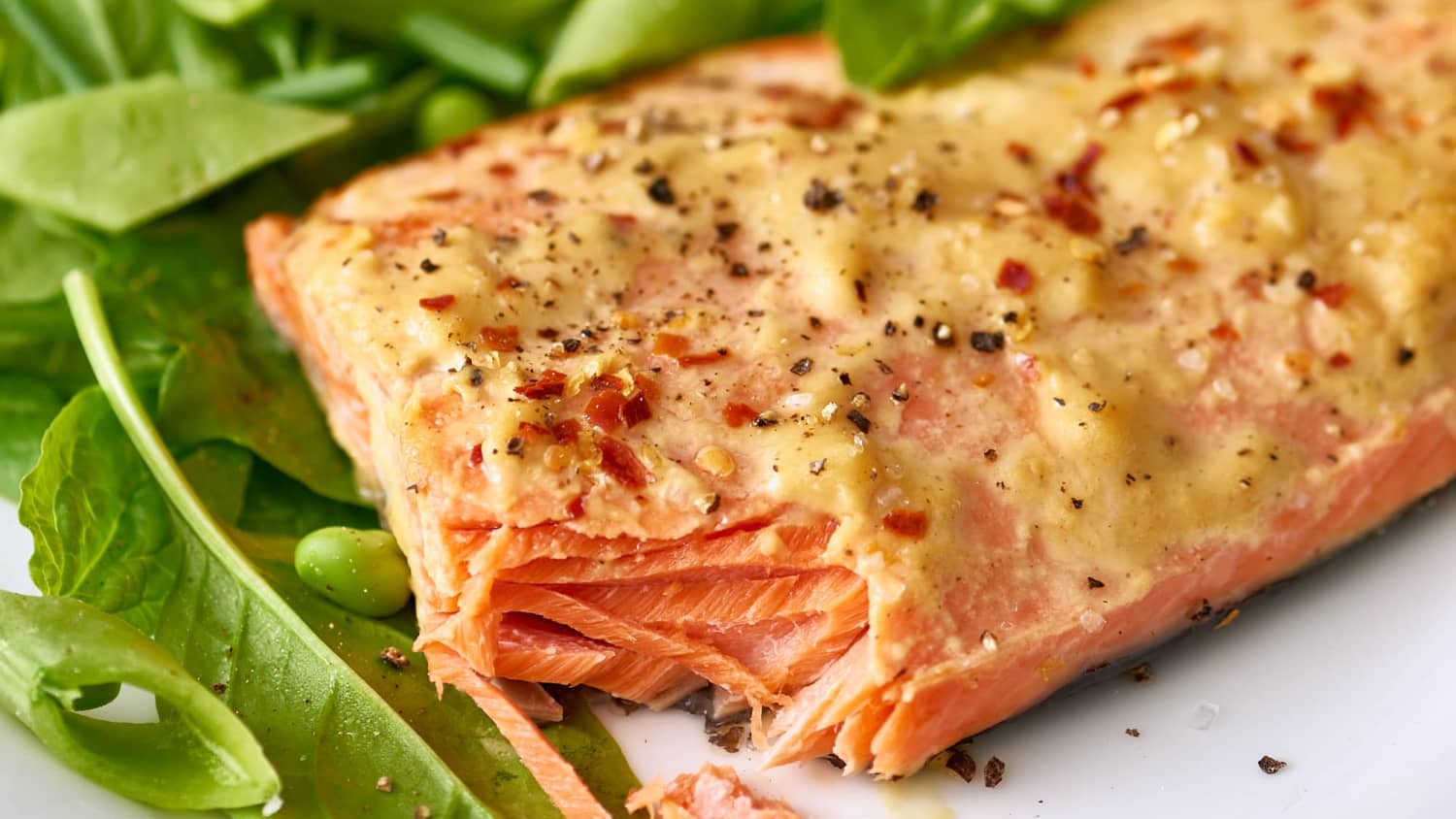
How to Cook Frozen Salmon in the Oven
Ingredients
2 (6-ounce) frozen salmon fillets (do not thaw)
3 tablespoons Dijon mustard
2 teaspoons maple syrup
2 cloves garlic, minced
1/2 teaspoon red pepper flakes (optional)
1/2 teaspoon kosher salt
Description
David’s note: times are often too short for large pieces. Add more time
Directions
Heat the oven to 425°F. Arrange a rack in the middle of the oven and heat to 425°F. Place the frozen salmon fillets skin-side down in an 8x8-inch baking dish.
Combine the mustard, maple syrup, garlic, and salt in a small bowl. Place the mustard, maple syrup, garlic, red pepper flakes if using, and salt in a small bowl and stir to combine.
Brush the salmon with the mustard mixture. Brush or spoon all of the mustard mixture evenly over the salmon.
Cover the baking dish and bake for 15 minutes. Cover the baking dish tightly with aluminum foil. Roast for 15 minutes, until a knife can pierce the salmon completely with only slight, icy resistance.
Uncover and roast for another 8 to 10 minutes. Carefully remove the foil. Continue roasting until the salmon can be easily flaked with a fork or a probe thermometer inserted in the thickest part of the salmon registers 145°F, 8 to 10 minutes more. Wild salmon tends to cook faster than farm-rasied salmon, so begin checking salmon at 8 minutes. The flesh should appear moist, but not raw or translucent.
Rest and serve. Remove the salmon from the oven and let rest uncovered for 3 minutes. Serve with a hearty salad or quick pasta side.
Notes
Storage: Leftover salmon can be refrigerated in an airtight container for up to 3 days.
Nutrition
alcohol-free
paleo
dairy-free
low-carb
egg-free
peanut-free
shellfish-free
pork-free
pescatarian
gluten-free
tree-nut-free
soy-free
wheat-free
red-meat-free
no-oil-added
Calories 389
Fat 23.6 g (36.3%)
Saturated 5.2 g (26.2%)
Carbs 6.8 g (2.3%)
Fiber 1.0 g (3.9%)
Sugars 4.3 g
Protein 35.8 g (71.5%)
Sodium 470.4 mg (19.6%)